Dr. Winnie Henderson Introduces the Pacific Northwest's First Endoscopic Nipple-Sparing Mastectomy (E-NSM) at PeaceHealth Sacred Heart Medical Center at RiverBend
November 16, 2026 – Patients facing breast cancer or prophylactic risk-reducing breast surgery in the Pacific Northwest now have access to a new minimally invasive option: endoscopic nipple-sparing mastectomy (E-NSM). Winnie Henderson, MD, PhD, FACS, CGRA, of Oregon Surgical Wellness (OSW), a division of Willamette Valley Cancer Institute and Research Center (WVCI), recently performed the region’s first E-NSM at PeaceHealth Sacred Heart Medical Center at RiverBend.
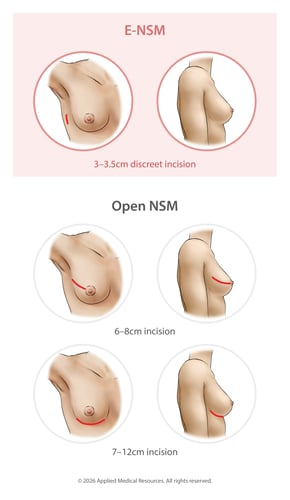
Unlike conventional nipple-sparing mastectomies, which require an incision of about two to four inches beneath the breast,
E-NSM uses a single incision of just over an inch placed discreetly away from the breast near the underarm, leaving no visible scar on the breast. Using the GelPOINT® Mini access platform and high-definition endoscopic cameras, surgeons get a magnified view of the tissue so they can remove the breast while preserving the skin, nipple, and areola. Single-port (SP) mastectomy can also be performed with a SP Robotic Surgical System (SP rNSM), but that technology is not available in many communities, so the GelPOINT® Mini access platform gives facilities without robotic systems a way to offer single-port mastectomy.
“This new minimally invasive approach to mastectomy directly aligns with our Hidden Scar program’s mission to reduce visible scarring and pain for better patient outcomes and quality of life,” said Dr. Henderson. “It benefits the patient through a smaller incision, less pain, and a shorter recovery, and as a surgeon, it is more ergonomic and efficient. It is a true win-win.”
A 2025 study published in BJS Open confirms that E-NSM offers the same cancer safety as conventional surgery while delivering higher cosmetic satisfaction, a lower risk of tissue complications, and potential advantages in preserving skin and nipple sensation. 1
For “Lisa” (name changed to protect patient privacy), becoming Oregon’s first E-NSM patient offered hope for an easier recovery.
“I was a little nervous for the surgery, but as a cancer patient, I’ve suffered through so much already. I was willing to try this if it had a better chance at an easier recovery and better cosmetic look,” said Lisa. “I was expecting a lot worse. It is painful, of course, but I was told I likely wouldn’t have sensation, yet I still have sensation just a week out from surgery. I’m glad I could be part of finding a way to make this procedure better and help someone else out.”
Breast cancer affects one in eight U.S. women and remains the most common cancer diagnosis among American women.2 While E-NSM is an option for both early-stage breast cancer patients and those with hereditary risks like BRCA mutations, it is not right for everyone. Ideal candidates are those whose tumors are located safely away from the nipple, and whose breast anatomy features smaller cup sizes (A, B, or C) without significant drooping or sagging (ptosis). Because many high-risk patients fit this profile, the procedure fits naturally with Dr. Henderson’s work leading OSW’s High-Risk Breast Clinic in Springfield.
“When I realized the U.S. was lagging behind Asia and Europe, where surgeons have performed E-NSM for years, I saw an opportunity to learn an innovative technique that makes care better for our breast patients,” added Dr. Henderson. “Investing in specialized training allows us to bring the most advanced surgical options right here to our community. WVCI is excited to be the trailblazer in offering E-NSM as part of the standard surgical treatment for the suitable patients.”
About Winnie Henderson, MD, PhD, FACS, CGRA
A Hong Kong immigrant and first-generation college graduate, Dr. Henderson earned her MD and PhD at Oregon Health & Science University (OHSU), where she also completed her surgical training. One of only three surgeons nationwide certified in Cancer Genetic Risk Assessment (CGRA), she directs OSW’s Breast Surgical Oncology Clinic and High-Risk Breast Clinic in Springfield, is an affiliated associate professor at OHSU and a published researcher, serves on national surgical committees, and volunteers on surgical missions in Guatemala.
About Oregon Surgical Wellness
Oregon Surgical Wellness (OSW), a division of Willamette Valley Cancer Institute and Research Center (WVCI), provides specialized breast surgical oncology and Hidden Scar surgery in Springfield, Albany, Corvallis, and Newport. Part of The US Oncology Network, WVCI delivers comprehensive cancer care and clinical trials across the Willamette Valley and Oregon Coast. Learn more at OregonSurgicalWellness.com or OregonCancer.com.
Media Contact:
Christy Curtis
Willamette Valley Cancer Institute and Research Center
541-632-3156
Media Assets:
E-NSM vs. Open NSM (Applied Medical)
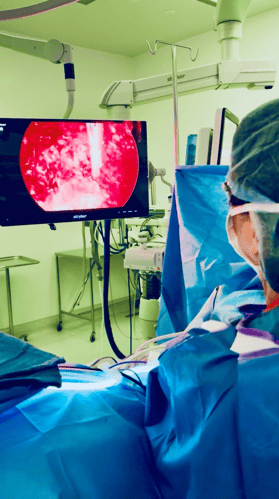
Dr. Henderson performs E-NSM at PHSHMCRB
Reference
1. Carroll A, Robles C, Lai HW, et al. Oncological, surgical, and cosmetic outcomes of endoscopic versus conventional nipple-sparing mastectomy: meta-analysis. BJS Open. 2025;9(3):zraf011. doi:10.1093/bjsopen/zraf011.
WVCI Physician Bo Wang, M.D. Contributes to Promising Advance in KRAS-Mutated Lung Cancer
 October 25, 2026 - A major Phase III clinical trial is offering encouraging new evidence for patients with a specific type of advanced non-small cell lung cancer (NSCLC). The results, published in the New England Journal of Medicine, showed that the targeted therapy divarasib improved both progression-free and overall survival for patients whose tumors have a KRAS G12C mutation. Bo Wang, MD, a medical oncologist at Willamette Valley Cancer Institute and Research Center (WVCI), was an investigator and co-author of the study.
The Phase III Krascendo 1 trial compared divarasib with two currently approved KRAS G12C inhibitors, sotorasib and adagrasib, in patients with previously treated advanced or metastatic NSCLC. Patients receiving divarasib had a median progression-free survival of 9.8 months compared with 5.7 months with the other therapies. Median overall survival was 17.7 months compared with 12 months. [Divarasib...f Medicine]
“This is potentially practice-changing data,” said Dr. Wang. “For the first time, we have a study showing that a next-generation KRAS-targeted therapy can outperform existing targeted treatment options in a randomized phase III trial.” [Sarah Cann...ung Cancer]
The findings also highlight the growing importance of genomic testing in lung cancer. Identifying mutations such as KRAS G12C can help oncologists determine whether patients may benefit from targeted therapies or qualify for clinical trials.
WVCI participates in clinical trials through Sarah Cannon Research Institute (SCRI), helping bring research opportunities and promising new therapies to patients in the community. Dr. Wang serves on SCRI’s Lung Cancer Research Executive Committee and has helped bring more than 20 lung cancer clinical trials to patients in the Eugene-Springfield area.
For more information on clinical trials available through WVCI and SCRI, please visit Cancer Research & Clinical Trials | Willamette Valley Cancer Institute
WVCI Expands Access to Advanced PET/CT Technology to Strengthen Comprehensive Cancer Care Offering
Powerful new PET/CT technology advances WVCI’s commitment to state-of-the-art imaging, coordinated cancer care, and the future introduction of radiopharmaceutical capabilities.
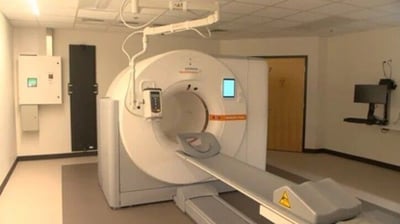 EUGENE, Ore. — August 11, 2026 — Willamette Valley Cancer Institute and Research Center (“WVCI”) announces the addition of PET/CT imaging technology with the installation of a new Siemens Biograph Trinion PET/CT scanner at its Eugene location this month. The technology provides patients a new, convenient option for advanced imaging and supports a higher level of coordinated cancer care for patients in the Willamette Valley.
PET/CT imaging combines PET (positron emission tomography), which shows tumor activity and location, with CT (computed tomography), which shows detailed images of the body’s anatomy, in one advanced scan. Together, these technologies help physicians identify health concerns quickly and accurately, supporting early detection, accurate diagnosis, and confident treatment planning.
By using PET/CT imaging early in the care planning process, WVCI care teams can see where cancer may be present and whether it has spread. This information helps physicians determine the stage of cancer, plan the next steps in care, and monitor how well treatment is working over time.
“Our new scanner gives our physicians highly detailed images that can detect exceptionally small areas of concern,” said Tina Nelson, Senior PET/CT technologist at WVCI.
The new PET/CT system is also designed with patient experience in mind. Faster, lower-dose imaging may help shorten the time patients spend in the scanner and limit radiation exposure. Comfort features, including mood lighting and continued communication with imaging staff, are intended to help patients feel informed, supported, and more at ease during the exam.
“We want the experience to feel as reassuring as possible,” explains Nelson. “The new features help our imaging team do that by staying connected with patients and fostering a calming environment, which helps minimize clinical anxiety.”
PET/CT technology also supports WVCI’s introduction of radiopharmaceutical capabilities later this year. Radiopharmaceuticals are specialized medicines that contain small amounts of radioactive material and may be used to help diagnose and, in some cases, treat certain cancers. As this program develops, WVCI will share additional information with patients, referring providers, and community partners.
“For patients, this is about more than new technology,” Nelson said. “It brings cutting-edge imaging to where our patients are, alongside the cancer care team they already know. It’s helping reduce the physical and emotional burden of traveling to multiple locations for separate appointments.”
The new PET/CT scanner is available now for patients of WVCI. Details about future radiopharmaceutical capabilities will be shared as they are finalized later this year.
Patients who would like more information about WVCI’s imaging and cancer care services may call 541.683.5001.